Mapping the Women of Jasper County
If you're here, I hope you've been able to read the first post about how I embarked on curating a small exhibit/collection from the Jasper County Women's Committee Census Cards. I'll explain more about what this whole census was for later, but for right now: with details about 3,000 cards facing me, I needed to figure out the best way to share a cross-section of Jasper County women in 1918.
One of the most helpful things at this juncture was printing up a map of Jasper County with its townships labeled. I read through my notes about the transcribed cards. We could call these notes either messy or organic (this seems more flattering). As I read, I wrote down the names of 1-2 women from each township on the map. As I went, I checked the cards to verify I wasn't overlapping too much. I did not want only young women in their thirties in all the townships, for instance, although this could be interesting for comparative research later.
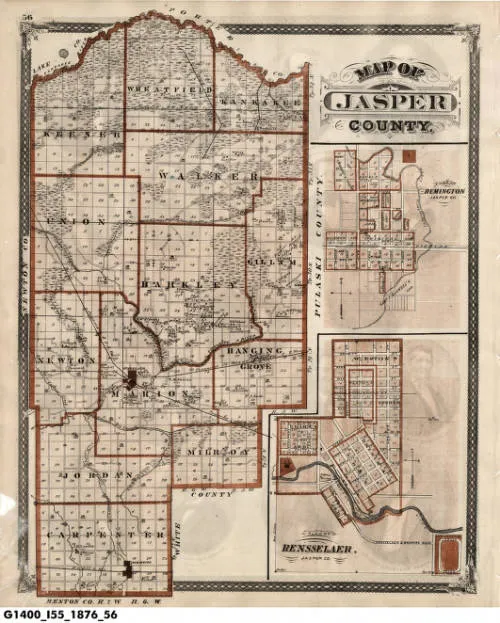
This fabulous 1876 Jasper County map with its townships delineated is from the Indiana Historical Society. Item ID G1400_I55_1876_56
With this map and census work, I wanted to curate a small sample of the various women you might meet in Jasper County when the registration was collected. Thus, I looked for an older widow, a young farmer's wife, an older married a woman, a woman who was not a housekeeper, etc. It was not perfect, but by funneling down categories and making sure each of the townships was represented, I had a better path forward.
Here I cannot emphasize enough how helpful digitized newspapers were for this project. Newspapers are a wealth of information about women. Although I'd delved deeply into newspapers on microfilm for my Union County project, the digitized version of many papers was more efficient. Hoosier State Chronicles from the Indiana State Library is a great free collection. Historic newspapers functioned like our own social media postings today. We think of newspapers for big events only, but that is not an accurate representation for this time period and these newspapers. Perhaps they knew better than we do that small events connect communities with many seemingly invisible bonds. Searching for these women led me to blurbs about grocery store trips, outings to other towns, family events, school teacher listings, and more.
One event covered extensively in the newspapers: Minnie Healey's experience surviving a tornado. Her story helped me unlock more stories about the German & Irish immigrant communities in rural Jasper County... but that will need to wait until next time.